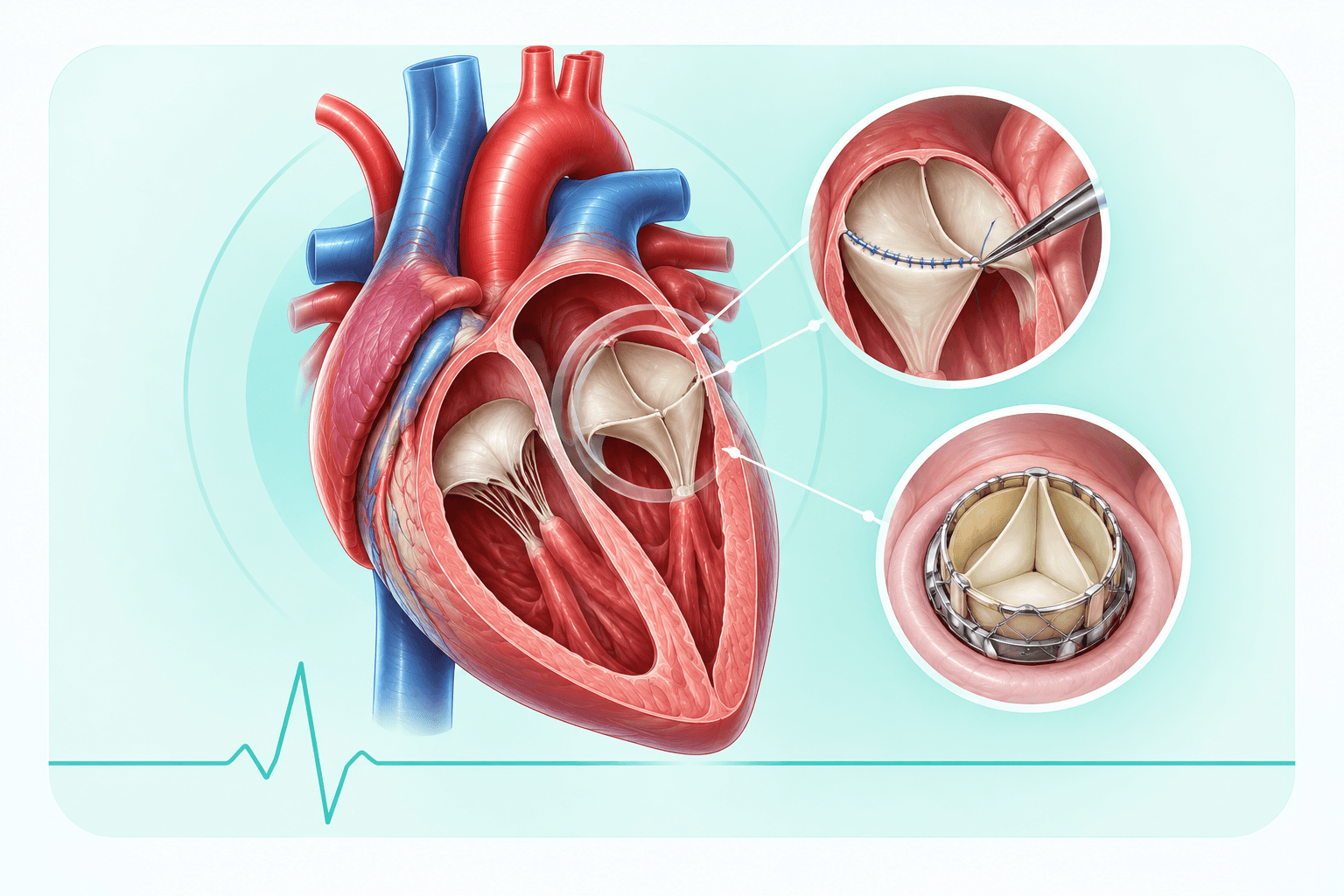


Aortic valve repair vs replacement is an important decision for patients diagnosed with aortic valve disease. While both procedures are designed to restore normal blood flow through the heart, they are fundamentally different.
Aortic valve repair aims to preserve and reconstruct your own valve. Aortic valve replacement removes the diseased valve and replaces it with a mechanical or biological prosthetic valve.
As a cardiac and aortic surgeon, I believe the most important question is not simply “Which surgery is better?” but rather: “Which procedure is safest and most durable for this particular patient’s valve, heart and aorta?”
The answer depends on the type and severity of aortic valve disease, the anatomy of the valve, age, associated aortic disease, heart function and whether a durable repair is technically achievable.
Medical note: Aortic valve treatment decisions are highly individual. The right procedure depends on a patient’s valve anatomy, the severity of the disease, heart function, the condition of the aorta and overall health.
What Is the Aortic Valve?
The aortic valve is one of the four valves in your heart. It lies between the left ventricle and the aorta, the body’s largest artery.
When your heart contracts, the aortic valve opens and allows oxygen-rich blood to flow from the left ventricle into the aorta and throughout the body. When the heart relaxes, the valve closes to prevent blood from flowing backward.
When the aortic valve becomes diseased, it may either become:
- Narrowed — aortic stenosis
- Leaky — aortic regurgitation or aortic insufficiency
Depending on the condition, a patient may require monitoring, medication, aortic valve repair, aortic valve replacement, or another form of intervention.
Aortic Valve Repair vs Replacement: What Is the Difference?
The simplest way to understand the difference is:
Aortic Valve Repair
The surgeon preserves your own aortic valve and reconstructs the damaged valve so that it can function properly.
Aortic Valve Replacement
The diseased valve is removed and replaced with a mechanical valve or biological/tissue valve.
| Aortic Valve Repair | Aortic Valve Replacement |
|---|---|
| Preserves the patient’s own valve | Diseased valve is removed |
| Uses reconstructive techniques | Uses a prosthetic valve |
| No prosthetic valve required | Mechanical or tissue valve |
| Can be an excellent option in selected patients | Appropriate for many forms of advanced valve disease |
| Avoids prosthetic valve-related issues when successful | Mechanical valves usually require lifelong anticoagulation |
| Requires suitable valve anatomy | Can be performed when repair isn’t feasible |
The right choice depends on the individual patient.
When Is Aortic Valve Repair Considered?
Aortic valve repair is not appropriate for every patient. The possibility of repair depends heavily on the anatomy and condition of the valve.
Repair may be considered particularly in selected patients with aortic regurgitation, where the valve leaflets are structurally suitable for reconstruction.
Some causes of aortic regurgitation include:
- Bicuspid aortic valve
- Abnormal valve leaflet structure
- Aortic root enlargement
- Aortic aneurysm
- Prolapse of an aortic valve leaflet
- Infective endocarditis in selected cases
- Congenital abnormalities
The surgeon evaluates the valve using detailed echocardiography and, when necessary, CT or cardiac MRI before deciding whether a durable repair is achievable.
What Does Aortic Valve Repair Involve?
There is no single technique called “aortic valve repair.” The repair is tailored to the patient’s valve anatomy.
Depending on the problem, a surgeon may:
- Repair abnormal valve leaflets
- Correct leaflet prolapse
- Reconstruct or reshape the valve
- Repair the commissures
- Correct the geometry of the valve
- Address associated aortic root enlargement
In some patients, the problem isn’t only the valve itself. For example, enlargement of the aortic root can prevent otherwise healthy valve leaflets from meeting properly. In such cases, treating the aortic root may restore proper valve function.
What Is Aortic Valve Replacement?
When the aortic valve is too damaged or unsuitable for durable repair, aortic valve replacement (AVR) may be recommended. During replacement surgery, the diseased valve is removed and replaced with a prosthetic valve.
There are two major types.
Mechanical Aortic Valve
A mechanical valve is made from durable artificial materials.
Advantages:
- Excellent long-term durability
- Designed to last for many years
- Particularly useful for selected younger patients
Consideration: Patients with mechanical valves generally require lifelong anticoagulation with blood-thinning medication to reduce the risk of blood clots.
Biological or Tissue Aortic Valve
A tissue valve is made from biological material. It may be suitable for patients where avoiding lifelong anticoagulation is an important consideration.
However, tissue valves can deteriorate over time, and younger patients may require another intervention in the future depending on their age and individual circumstances.
The choice between a mechanical and tissue valve should be discussed carefully with your cardiac surgeon.
Aortic Valve Repair vs Replacement: Which Is Better?
There is no universal answer.
If a patient’s native aortic valve can be repaired safely and a durable result is expected, valve preservation can offer important advantages. However, attempting a repair when the valve anatomy is unsuitable may not be the best approach.
A successful repair should provide:
- Good valve function
- Adequate durability
- Minimal residual regurgitation
- Good heart function
- A low likelihood of needing another operation
If these goals cannot reasonably be achieved through repair, valve replacement may be the safer and more durable option. This is why the decision should be based on the patient’s anatomy rather than a blanket preference for “repair” or “replacement.”
What Are the Advantages of Aortic Valve Repair?
When a durable repair is possible, preserving the patient’s own valve can have several potential advantages.
1. Preserving the Native Valve
The patient’s own valve remains in place rather than being replaced with a prosthetic valve.
2. Avoiding a Prosthetic Valve
Successful repair avoids some of the long-term considerations associated with prosthetic valves.
3. Avoiding Lifelong Anticoagulation in Appropriate Patients
Unlike mechanical valve replacement, successful native-valve repair does not inherently require lifelong anticoagulation solely because of the repaired valve.
4. Preserving Natural Valve Function
A well-performed repair aims to restore the patient’s own valve anatomy and function.
5. Particularly Valuable for Selected Younger Patients
For younger patients with suitable valve anatomy, avoiding or delaying prosthetic valve replacement may be an important consideration.
When Is Aortic Valve Replacement Preferred?
Aortic valve replacement may be more appropriate when:
- The valve is severely damaged
- The valve leaflets are heavily calcified
- Repair is unlikely to be durable
- There is severe aortic stenosis
- The valve anatomy is unsuitable for reconstruction
- Previous valve surgery has failed
- There is extensive infection or tissue destruction
- A reliable repair cannot be achieved
In patients with advanced aortic stenosis, replacement is generally the established surgical treatment because the valve is often heavily calcified and structurally unsuitable for conventional repair.
Aortic Regurgitation: Repair or Replacement?
This is where the distinction becomes particularly important. Patients with aortic regurgitation may sometimes have a valve that is leaking but not irreversibly damaged. For selected patients, aortic valve repair can therefore be considered.
The surgeon assesses:
- Leaflet quality
- Leaflet prolapse
- Cusp size and symmetry
- Commissural anatomy
- Aortic root dimensions
- Ascending aorta
- Left ventricular function
If the valve is repairable and a durable result is expected, preservation may be an excellent option. If the valve is severely damaged, replacement may provide a more predictable result.
What If I Have an Aortic Root Aneurysm and Aortic Regurgitation?
This is an important situation because the problem may involve both the valve and the aorta. An enlarged aortic root can cause the aortic valve to leak even when the valve leaflets themselves are relatively healthy.
In selected patients, valve-sparing aortic root replacement can address the enlarged aortic root while preserving the patient’s native aortic valve. Procedures such as the David procedure may be used in suitable patients.
Another option is the Bentall procedure, which replaces the aortic root and aortic valve using a composite graft and prosthetic valve.
Therefore, when aortic regurgitation is associated with an aortic root aneurysm, the treatment decision requires assessment of both the valve and the aorta.
Aortic Valve Repair vs Replacement: Recovery
Recovery depends on the type of surgery, surgical approach, patient’s overall health and whether other procedures are performed at the same time.
After open aortic valve surgery, patients generally spend time in intensive care followed by recovery in the hospital.
Recovery may include:
- Monitoring heart rhythm and vital signs
- Pain management
- Wound care
- Breathing exercises
- Gradual mobilisation
- Cardiac rehabilitation
- Follow-up echocardiography
Many patients require several weeks before returning to their usual activities. Your recovery timeline will be individualized based on your procedure and health.
What Are the Risks of Aortic Valve Repair?
Although valve repair preserves the native valve, it is still major heart surgery.
Potential complications include:
- Bleeding
- Infection
- Stroke
- Abnormal heart rhythms
- Blood clots
- Kidney problems
- Heart attack
- Residual or recurrent aortic regurgitation
- Need for further intervention
One of the most important considerations is durability. A repair should not simply look good immediately after surgery. The goal is to achieve a stable and durable valve function over the long term.
What Are the Risks of Aortic Valve Replacement?
Aortic valve replacement also carries risks, including:
- Bleeding
- Infection
- Stroke
- Abnormal heart rhythm
- Blood clots
- Kidney complications
- Prosthetic valve dysfunction
- Prosthetic valve infection
- Need for future intervention
There are also valve-specific considerations. For example, mechanical valves require lifelong anticoagulation, while tissue valves have a limited lifespan and may eventually deteriorate.
Which Aortic Valve Is Best for You?
There is no single valve or procedure that is best for everyone. During consultation, I consider several factors, including:
Your Age
Age can influence whether a mechanical valve, tissue valve or valve preservation is appropriate.
Your Valve Anatomy
A detailed echocardiographic assessment helps determine whether repair is technically possible.
Severity of Valve Disease
Severe aortic regurgitation and severe aortic stenosis may require different treatment strategies.
Heart Function
Left ventricular size and function are important when deciding the timing and type of intervention.
Aortic Root and Ascending Aorta
If the aorta is enlarged, treatment may need to address the aorta as well as the valve.
Associated Conditions
Conditions such as bicuspid aortic valve, connective tissue disorders and previous cardiac surgery can influence the surgical strategy.
Long-Term Expectations
The decision should consider not only the immediate operation but also the patient’s expected quality of life and the possibility of future interventions.
Aortic Valve Repair vs Replacement: The Decision Should Be Individualized
One of the most common questions I hear from patients is: “Doctor, should I repair my valve or replace it?”
My answer is that the decision cannot be made from the diagnosis alone. Two patients may both have severe aortic regurgitation but have completely different valve anatomy.
One may have a valve that can be repaired with a durable result. Another may have extensive valve damage where replacement is safer and more predictable.
Therefore, the goal is not simply to repair the valve at any cost. The goal is to choose the treatment that gives the patient the safest and most durable long-term result.
Aortic Valve Repair and Replacement in Chennai
If you have been diagnosed with aortic valve disease, severe aortic regurgitation, bicuspid aortic valve or an aortic root aneurysm, the next step is a detailed assessment of your valve and aorta.
At consultation, I would typically evaluate:
- Echocardiography findings
- Aortic valve anatomy
- Severity of regurgitation or stenosis
- Left ventricular size and function
- Aortic root dimensions
- Ascending aorta
- Symptoms and exercise capacity
- Overall health and surgical risk
Based on these findings, we can determine whether aortic valve repair, aortic valve replacement, valve-sparing aortic root replacement, Bentall procedure or another treatment approach is appropriate.
The aim is not just to treat the valve. It is to choose a treatment that provides the best possible long-term outcome for the individual patient.
Frequently Asked Questions
- Is aortic valve repair better than replacement?
- For appropriately selected patients, a durable aortic valve repair can provide important advantages because it preserves the patient’s native valve and avoids a prosthetic valve. However, replacement is the better option when the valve cannot be reliably repaired.
- Can aortic regurgitation be treated with valve repair?
- Yes. Selected patients with aortic regurgitation may be candidates for aortic valve repair, depending on the valve anatomy and the likelihood of achieving a durable result.
- Is aortic valve repair possible for bicuspid aortic valve?
- In selected patients, yes. Bicuspid aortic valve anatomy varies considerably, and repair may be possible when the valve structure is suitable.
- Does aortic valve repair require blood thinners?
- A repaired native aortic valve does not inherently require lifelong anticoagulation solely because of the repair. However, your doctor may prescribe medication for other medical reasons.
- How long does an artificial aortic valve last?
- Mechanical valves are designed for long-term durability. Tissue valves can deteriorate over time, with durability varying according to age, valve type and individual factors.
- What is the difference between the Bentall procedure and valve-sparing root replacement?
- The Bentall procedure replaces both the aortic root and aortic valve. Valve-sparing aortic root replacement replaces the diseased aortic root while preserving the patient’s own aortic valve when the valve is suitable for preservation.
- Can an aortic valve be repaired instead of replaced?
- Yes, but only when the valve anatomy is suitable and a durable repair is realistically achievable.
- Which is better for aortic regurgitation: repair or replacement?
- In selected patients with suitable anatomy, durable aortic valve repair can be an excellent option. When repair is unlikely to provide a durable result, aortic valve replacement may be the safer choice.